County-wide responsibility
Ports, utilities, schools, and large events across the county, often with the sheriff as the agency other departments call for mutual aid. A county program sets the standard others lean on.
Counter-drone readiness under SAFER SKIES
The SAFER SKIES Act and the new 28 CFR Part 124 rule let certified state, local, and correctional officers detect drones and, with further certification, mitigate them. As of July 1, the FBI's National Counter-UAS Training Center had trained 61 officers across 46 agencies.
Who this is for
Ports, utilities, schools, and large events across the county, often with the sheriff as the agency other departments call for mutual aid. A county program sets the standard others lean on.
Stadiums, parades, and festivals draw drones and crowds together. Planning for an event starts weeks out, and so does the paperwork the rule requires.
Drone drops of contraband into jails and prisons are a known pattern. Detection at the perimeter, with a clear chain to a certified responder, is where most facilities start.
Video briefing
The certification tiers, the policy and reporting requirements, the bottleneck in mitigation training, and a practical path for the first 90 days.
Get ready
The rule gives your agency the authority. It does not give you a program. Each step is a federal requirement. The three in rust run on fixed clocks, and missing one can mean an audit finding or a suspended authority.
A senior Agency Approving Official, a program lead, and counsel who will certify plans.
Detection certification is online. Mitigation certification comes only from the FBI's training center, which had trained 61 officers by July 1.
An implementation policy, reviewed by counsel and attested through the federal portal.
Signed by the approving official, certified by counsel. Covers up to 30 days, or a year at a fixed site.
Required before mitigation, so the FAA and spectrum managers can coordinate. Emergencies allow notice within 2 hours after.
Notify air traffic control within 5 minutes of mitigation. File the post-operation report within 48 hours.
Delete control-signal data by day 180 unless an exception applies. Keep the audit trail 6 years. File semiannual summaries.
Deadlines from 28 CFR Part 124, effective July 1, 2026.
Waiting versus preparing
A practical first 90 days
Protected sites, recurring events, current equipment, and staffing.
Detection team through the online course, with a training record.
Build mitigation capacity, or rely on a certified partner, and document why.
Policy and procedures drafted for counsel and command review.
Deliverables
Where the agency stands on people, policy, plans, reporting, and partners.
Launch points and responding authority around the sites you protect.
Implementation policy, training plan, and procedures, drafted for counsel's review.
Reporting support, data-minimization reviews, and audit preparation.
Built for Florida agencies. Programs account for Florida's drone statutes and Chapter 119 public-records law, so sensitive operational detail is handled with the applicable exemptions in mind. The work supports agency counsel and federal partners. It never replaces them.
Pocket reference
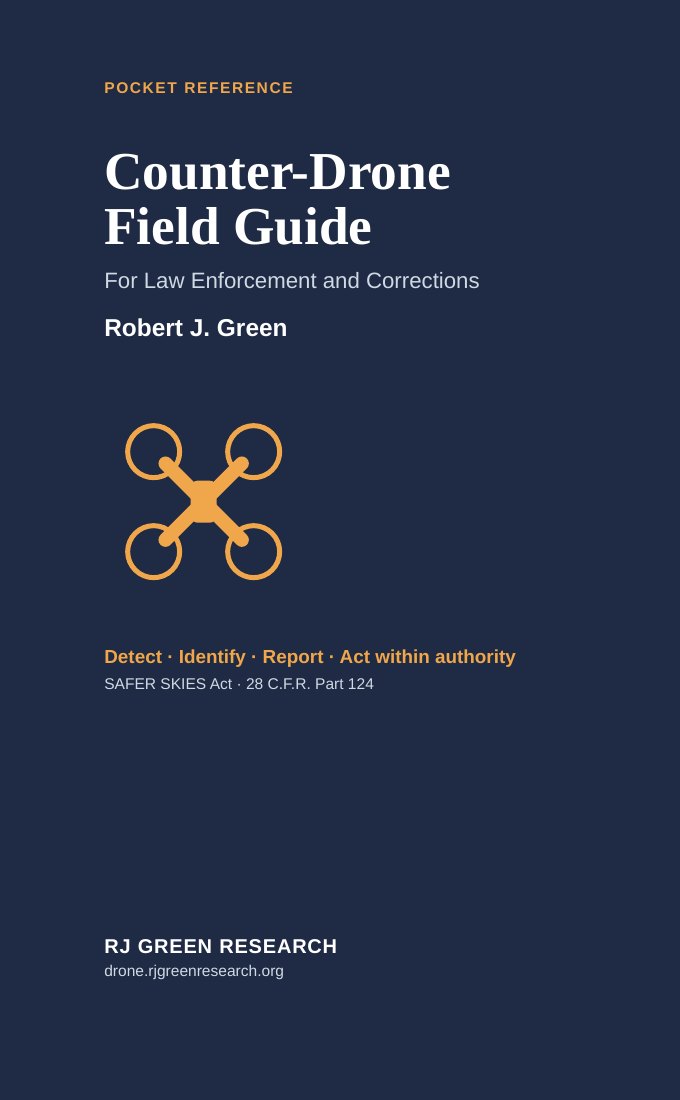
A 38-page guide that fits a uniform pocket: drone types and silhouettes, Remote ID, sensors and their gaps, the patrol response, the federal clocks under 28 CFR Part 124, evidence, and privacy. It closes with a call chain, a sighting log, and three incident reports, so every sighting is recorded the same way.
How it starts
Sixty minutes on what Part 124 requires, the clocks, the penalties, and the routes to coverage, including mutual aid for agencies that do not want their own program.
Your jail, venue, or port: likely launch areas from public data, the places to watch first, and a checked call sheet, in five business days. Credited toward the readiness assessment within 90 days.
A scored checklist against Part 124, the items that block lawful operation, and a 90-day roadmap for command staff.
Every paid engagement has a fixed fee or rate agreed in writing before work begins. Site operators and insurers: see drone incursion exposure.
The path
Readiness assessment, detection and warning policy, portal attestation, and a first Operations Plan.
Eight gates to a first authorized mitigation operation, or a written route through an accredited partner or federal support.
Reviews, renewals, semiannual summaries, and audit-ready records, every year. See compliance.
Smaller departments do not need a program of their own. Under 28 CFR 124.4(c), an accredited agency can cover other agencies under a written mutual aid arrangement, and a small agency needs no equipment or accreditation to receive that support. A county regional program, led by the sheriff, sets that up once for every town in the county.
Common questions
Only the FBI's training center certifies operators, and certification is one of five requirements. The policy, counsel concurrence, portal attestation, Operations Plans, data procedures, and reports are the agency's to build.
Contractors may install and maintain systems but may not operate mitigation or make the credible threat call (124.4(b)). The policy and filings belong to the agency. RJ Green Research sells no equipment.
The interim rule is in force now, and operating without a current attestation is a violation today (124.6(f)). Documents are built to update when the final rule arrives.
No. The work is advisory and documentation only. It does not detect, track, or mitigate aircraft, and it does not provide training or certification.
Request a free briefing
Share the jurisdiction, the sites or events that concern you, and any deadline you are working against. The reply will propose briefing dates for your command staff.
Prefer direct contact? [email protected] or (321) 252-9283